What does the phrase hydro-clean tell you?
It tells you that the provider is describing a cleaning process involving water, but it does not establish every inclusion or the suitability of that process for your unit. A meaningful proposal identifies the equipment, accessible components and method limits. Treat a service name as the beginning of the discussion. It should not replace a written explanation of what will happen in your room.
Compare proposals for the same problem. A routine clean for a normally operating unit is different from an assessment of an indoor leak or repeated stopping. If one provider includes fault finding and another offers only accessible cleaning, their descriptions are not equivalent. Clarify the purpose before comparing anything else, otherwise a shorter scope can look complete simply because the unresolved symptom was omitted.
Ask the provider to identify what they need to know about your unit before confirming the method. Model information, room access and known damage can matter. A generic promise of a full clean may still be subject to practical exclusions. Those exclusions are useful information when they are specific and visible before the appointment, rather than discovered after work begins.
Make both proposals refer to the same equipment
Name the room and indoor head on each request. Supply the same safe room photograph and the same description of previous work or symptoms. If one proposal assumes a clear ground-level wall and another accounts for fixed furniture or an elevated installation, they are planning different jobs. The comparison should preserve the actual constraints instead of treating them as optional details.
State how many indoor heads are included and whether the outdoor arrangement is known. A multi-head system may share equipment, but do not infer connections without records or confirmation. Ask each provider to name the included heads individually. A household count that changes between requests makes a later comparison unreliable and can leave a room outside the appointment without anyone noticing.
If the request includes ducted equipment, describe that separately. A ducted outlet and a wall-mounted split head are not interchangeable units of cleaning work. Ask what parts of the ducted system are included and whether another inspection is necessary. Keep that proposal separate enough that a clear split-system comparison is not confused by unrelated roof-space or duct-access assumptions.
Identify the indoor components in each scope
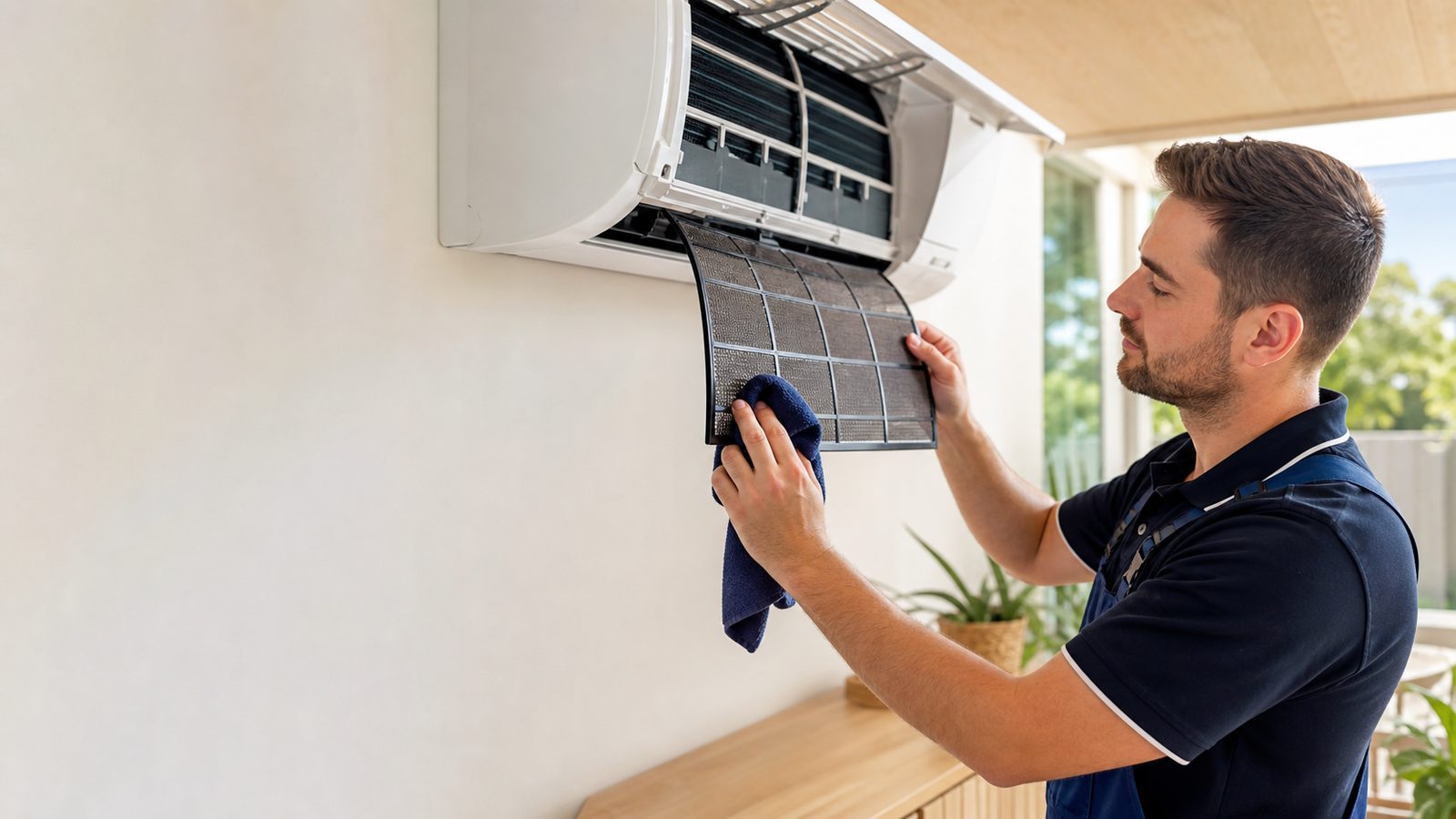
Look for a description of the accessible filters, coil, fan, casing and condensate components that the provider proposes to clean. The presence of one component in a photograph does not prove another is included. Ask which areas can be reached with the proposed method and which cannot. A component list is most useful when it also explains the boundaries of access.
Do not assume that removing more parts automatically means a better result. The appropriate method depends on the equipment and condition, and dismantling introduces its own access and reassembly questions. Ask the provider to explain their method for your model. This is a consumer scope question, not a set of instructions for taking apart the unit yourself.
Keep owner filter care separate from internal professional cleaning. Manufacturer guidance describes care that varies with the model and filter arrangement. A proposal limited to filters should say so. Equally, a proposal for internal washing should not imply that every household filter can be washed in the same way or that you must carry out preliminary maintenance before the provider attends.
Where does the drainage scope stop?
Ask whether the proposal covers the accessible drain pan, a section of condensate line, a drainage observation or some combination of these. Those descriptions refer to different work. The words drain clean are incomplete if nobody explains where access ends. Concealed piping or shared building infrastructure may fall outside the visit, and that limit should be visible in the written scope.
If you have reported leakage, ask how the provider distinguishes cleaning from investigating its cause. A drainage observation after washing may be useful without resolving every installation or building-water issue. The report should state what was actually assessed. Do not accept an assumption that every indoor drip must be solved by washing the unit, and do not attempt to prove a blockage yourself.
For an apartment, tell both providers the same information about the drain route and building access. If the route is unknown, leave it unknown. A contractor should not be asked to clear shared piping without the appropriate arrangements being established. The apartment access guide can help organise those conversations while keeping responsibility and authority separate from the cleaning comparison.
How will the room and cleaning water be handled?
A scope should account for the room around the air conditioner. Ask about protection for the wall, floor and belongings below the head, along with containment of the water used. Describe fixed furniture and sensitive items in advance. A standard photograph of a cleaning setup elsewhere does not show that the method fits a unit above your desk or built-in cabinetry.
Ask where equipment will be placed and how collected water will be handled. Do not assume that a balcony edge, shared drain or nearby sink is an agreed disposal route. The provider needs to plan for the actual products and building arrangements. Your part is to supply accurate access information and avoid moving heavy objects or altering the installation without discussion.
Keep children, pets and other occupants outside the agreed work area. Ask whether the provider needs any room arrangements during and after the process. If someone must remain at home, explain the available space before booking. Clear working arrangements belong in a useful scope because a method that cannot be carried out in the occupied room is not a complete proposal for that job.
Ask about products without relying on marketing labels
If products are proposed, ask what they are intended to do and how the provider determines suitability for the equipment. Terms such as natural, sanitising or professional do not by themselves explain compatibility, handling or the expected outcome. Request the relevant product information where needed. Do not mix household cleaners or apply products inside the unit in preparation for the visit.
Describe any concern about residues or odour without demanding a particular chemical treatment. A smell does not identify its cause, and an application should not be presented as proof that hidden contamination or a health concern has been resolved. Keep the comparison focused on the proposed process and its stated limits. Avoid choosing a scope because it makes the largest unsupported promise.
Ask what room-use instructions follow the actual method. Those instructions should come from the provider and applicable product guidance, not an arbitrary waiting period copied from another job. If the household cannot accommodate the instructions, discuss that before work begins. An alternative arrangement or a different appointment may be needed, but the comparison should remain grounded in the work actually proposed.
Keep electrical and refrigerant work clearly separate
A cleaning proposal should identify how the provider handles a finding outside cleaning. Electrical work and refrigerant work require the relevant appropriately licensed professionals. Ask who would perform such work and how the additional scope would be explained and approved. A mention of servicing should not imply that every attending cleaner can investigate wiring or intervene in the refrigerant circuit.
The Australian Refrigeration Council provides a way to check credentials relevant to refrigerant work. Use it when that work is proposed rather than treating a displayed logo as enough information. Ask what problem the proposed intervention addresses. Reduced cooling alone is not a reason for a household to order a recharge without appropriate assessment of the system.
Warning symptoms should change the booking discussion before any comparison of cleaning methods. Burning, smoke, repeated tripping, shock or suspected electrical water damage require affected equipment to remain out of use pending qualified advice. Stay clear of wet or damaged electrical parts. An apparently thorough washing scope does not provide a safety clearance, including after a storm or flood event.
What completion checks and evidence are included?
Ask what the provider will observe or check after the agreed clean, and how that will be recorded. The answer should identify the limits of the check. An ordinary operating observation is different from fault diagnosis or a technical performance assessment. A proposal becomes clearer when it says which of those is included instead of using a broad phrase such as fully tested.
Request a written record linked to the room and unit. If photographs are included, ask that they be identifiable and explain what they show. Before-and-after images of an external cover cannot establish the condition of every internal surface. Images are more useful alongside a component-level description of the work, access limits and anything left for a separate visit.
Keep the original complaint visible in the completion discussion. If the booking was prompted by an odour, noise or drip, ask whether that observation remained and what happens next. A clean can be completed while an operating concern remains unresolved. The report should preserve both facts so the household does not confuse completion of a process with proof of the desired outcome.
Read two different scopes without inventing a winner
Imagine proposal A names filters, accessible coil surfaces, water protection and a written record, while proposal B names filters, fan access and drainage but says nothing about room protection. Neither description alone gives a complete side-by-side comparison. Ask A about fan and drain coverage, and ask B about protection and completion records. The missing words identify questions, not proof of poor workmanship.
Suppose both providers then explain those items, but one excludes a concealed drain and the other proposes a separate investigation. Keep that difference visible. If your request concerns a leak, the investigation may matter to the decision. If it is routine cleaning, it may be outside the immediate purpose. Match the scope to the observed need without pretending the broader proposal is automatically necessary.
A similarly careful comparison applies to exclusions for access or damaged parts. Ask what happens if the provider finds that the planned method cannot proceed. Will they stop, document the limitation and seek approval for another arrangement? A clear answer helps you assess how the visit is managed, even though it cannot guarantee a particular result before the equipment is seen.
Make the final decision using the actual written answers
Keep the clarified proposals together and check that each now refers to the same unit list, access situation and stated concern. Remove assumptions from your notes. If a provider has not confirmed a component, mark it unanswered rather than included. If you decide to proceed with a limited scope, retain the excluded items so they can be addressed separately if needed.
Agree how changes discovered on arrival will be handled. The person giving access may not be the person authorised to approve extra work, especially in a rental or apartment. Name the decision-maker and the contact route. This prevents a comparison made carefully beforehand from becoming an open-ended instruction when the contractor encounters a condition that was not visible in photographs.
The comparison tool below tracks which written proposal explains each topic. It deliberately produces clarification requests instead of a contractor score. Once both proposals describe an item, read their actual wording for differences in method and limits. A complete description helps you make an informed request; it does not establish workmanship, electrical safety, health outcomes or a guaranteed improvement in running costs.